UA-20248021-6
Showing posts with label gardening. Show all posts

Saturday, December 15, 2012

Praying Mantis - Super Garden "Pet"

I know that many of you don’t consider the Praying Mantis as a pet, but I just love these creatures in my garden! ...and I don't even have to feed or walk them! When I find their hardened tan foamy nests, I am all smiles! I know that there will be less damage to my flowers. These insects are ravenous eaters and do a lot to help get rid of harmful insects.


These are my photos of a praying mantis egg case (ootheca) with young just emerging. I was exceptionally lucky to be in the garden at just the right time to capture this moment! There had been a lot more mantises clinging to the case before I found it. Unfortunately, I hadn’t initially seen them when I was pruning this bush and got so excited when I did that I let go of the branch, causing most of the tiny creatures to be flung across the garden!
 
I love to watch these voracious eaters on my plants preying on annoying insects throughout the season. It’s neat to see them getting bigger by molting (splitting open their outside skeleton – exoskeleton – and emerging a size larger).
 
 
They have a different life cycle than most insects in that they have three stages: egg, nymph, adult. After the adults mate, the female lays a foamy egg-filled case that hardens. Eventually, tiny adult-looking insects emerge and molt many times, getting larger and larger throughout their lives until they reach adulthood. You may have read about the mating behavior of the adult female who sometimes eats her mate just after, or even during mating. Perhaps not knowing what is in store for him, the male is not deterred from this often fatal process!


Thursday, November 1, 2012

NEW PAINTING "Garden Tools with Sun Hat"


I love the creative process of gardening. Both my mother and grandmother were gardeners who inspired me. The tools in this painting are theirs and I love the beauty of the rust. This art print of my original watercolor would make a marvelous addition to your sun room or the perfect gift for the gardener in your life!

I thought that you would like to see how I create my watercolor paintings. After starting with a photograph of the still life on my kitchen table that captures the light at that moment, I begin to paint. The green ribbon on my hat blended too much with the greens in the background, so I changed it to red. Decision time begins when I have to plan what type of surface I want my leather gardening glove, rusty gardening tools, and straw sun hat to rest on. At first, I have to admit that I was timid. I wanted it to be a wooden bench, but was not real adventuresome about the colors of the wood. Finally, as you can see in the finished painting at the top, I threw away all inhibitions!


Not quite done. Check the top finished photo to see the refinements.
 
I'd love to hear your reactions to my latest watercolor painting!


Tuesday, May 8, 2012

UGLY LEAVES! WHAT TO DO?

What to do with ugly, dying leaves? It seems that gardeners never tire of creating ways to hide unsightly, yellowing daffodil and tulip leaves!

Once the flower blooms and the petals fall off, if you are crazy like me, you can cut the flower stalks so that the "fruit" won't have a chance to form. That way, the energy that it would take to form the seeds will instead go into the bulb for the next year.

As for the leaves, when they are still green but start to flop over, it is okay to cut off the top half of the leaves, allowing the remaining part of the leaves to continue photosynthesizing, sending food to the bulb (a storage stem). They will stay upright for a while longer. When the leaves turn yellow, you can cut them to the base of the plant. Some people braid them (sorry to say that I once did that), twist them and tuck them under themselves, and/or bend and push them under surrounding plants. All are fine to do and you just have to decide how much labor you are willing to put in.

If you live in the Philadelphia, PA area, don't forget to stop by the Tamanend Art Show, Saturday, May 19, from 9 a.m. to 4 p.m. You can check out my flower paintings, Bucks County covered bridges, and beach scenes. There will be lots of other artists displaying their work, too. All art will be for sale. Refreshments will be served.

For details http://uppermoreland.patch.com/events/tamanend-park-art-show-93ba8424

Happy Gardening!


Tuesday, May 1, 2012

TREE PEONIES & GET TO KNOW YOUR SEEDLINGS

 GARDENING TIP: Get to know your seedlings – the good, the bad, and the ugly. Once you can identify them, you’ll know when to pull ‘em, know when to walk away, know when to run. Well, maybe not “run,” just know when to move them if you want those plants to grow in other parts of your garden.

TREE PEONIES: Each spring, I look forward to the gorgeous flowers of this woody-stemmed plant. Although the blossoms last a brief time, especially if there's a hard down-pour, the fabulous crepe papery petals are worth the wait. Once the petals fall off, the plant still retains interest because of the beauty of the leaves and dark, peeling bark.


I've loved this plant for many years and never tire of painting it.


HAPPY GARDENING!


Saturday, April 7, 2012

GARDEN STRATEGY: NO MULCH, JUST GROUNDCOVER!

I absolutely love this season! With the perfect spring weather, it’s almost a pleasure to do the limited weeding that’s ahead. I say, “limited,” because with the strategy of NO MULCH, JUST GROUNDCOVER, I have very little weeding to do. By planting periwinkle (Vinca minor) in all of my garden beds, I’ve eliminated the mulching that I had been doing for over 30 years. All of my bulbs and perennials come up through it and the groundcover keeps in the moisture, preventing roots from drying out, even in the heat of summer. If you aren’t already doing this, you may want to give it a try – maybe only in a small portion of your garden, as a test patch. 

Red with Yellow Tulips

Grape hyacinths, tulips, heuchera, roses and narcissus growing through the periwinkle.
Bleeding Hearts, violets, and other perennials among the periwinkle.


When the first daffodils appeared, I painted this little girl trying to decide which flower she would choose. She's reaching for one, but looking at another! I hope that you enjoy her, along with my "Yellow Daffodil" painting!
"Girl with Daffodils" by Barbara Rosenzweig


"Yellow Daffodils"


Garden Tips for this Month:
  • Some of the plants that may be divided now are primrose, bleeding hearts, asters, primrose, iris, daylilies, and chrysogonum. This is best done before they get too large, avoiding excessive wilting or death.
  • To make plants bushier, cut back beautyberry, roses, St. John’s Wort, buddleia, and caryopteris in late March, early April.
  • Remove “weeds” (any plants that you do not want growing where they appear) as soon as you see them. One man’s weeds are another’s valued garden addition!

 Primrose

Narcissus

What are your favorite spring gardening tips?

Friday, June 3, 2011

MY JUNE FAVORITES

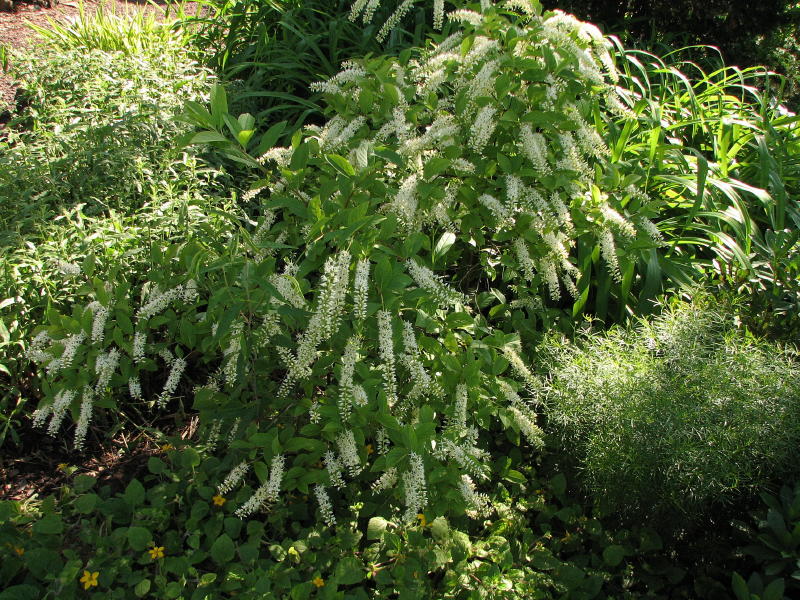
‘Henry Garnet’ Virginia Sweetspire (Itea virginica) is one of those shrubs that keeps on giving. Besides the lovely white floral spires that bloom mid-June, it often sends out new shoots a few inches from the main stem. If you leave them, the plant just gets wider. If you remove the shoot by sharply jamming your shovel between the shoot and main stem, you can dig up the shoot with its roots and plant it in a new location. I like to make clusters of three or five among the other plants. They look especially beautiful in a shaded area, although they are fine in full sun. This is fun to do with other plants, too, like Winterberry, to increase your own plants or share with gardening buddies. Periodically check under the bush for stems sporting the same leaves as the main plant. It is best to do this in the fall, although if you are diligent about making sure it is not wilting, any season will work.


Virginia Sweetspire (Itea virginica)

Indian Pink (Spigelia marilandica) adds a bright pop of color to any garden and is one of the plants preferred by hummingbirds. The vibrant and unusual flowers of this perennial never fail to bring a smile to my face.
Linked to "Pink Saturday."


Saturday, May 28, 2011

WHAT THE ...HELLEBORE!


Never thought that I’d ever say this, but I do love my hellebores! For over 35 years, I didn’t plant these gems because the lovely blossoms faced down instead of up. I know; dumb reason! Then I started seeing newer hybrids that somewhat faced sideways and were varied colors and shapes. Finally, I just couldn’t resist!
If you have a shaded area, do try these since they not only have long-lasting blossoms, but the leaves stay a wonderful glossy green throughout much of the year. Enjoy!


Sunday, April 24, 2011

NON-NATIVE BEAUTY - LESSER CELANDINE

When I started gardening around my home about 40 years ago, I spotted lovely early spring, delightfully yellow blossoms in nearby woods. I was told that they were probably marsh marigolds (Caltha palustris), a native in wetlands habitats of eastern United States. Being a novice and not having the wonderful availability of Google Search back then, I happily transplanted a small clump into my new woodland garden.

It’s now a love-hate relationship. I still love seeing these beauties bloom, but hate the job of removing them knowing that some of their abundant fingerlike tubers (up to two inches long!), produced by the roots, will remain behind to create new plants next year.

These lesser celandine, in the Buttercup family (Ranunculaceae), are also called Fig Buttercup and Pilewort. They are perennial, herbaceous flowering plants whose native range is Eurasia (Europe, Northern Africa, Western Asia, Caucasus, and Siberia). Originally introduced into the US as an ornamental plant, it’s still available here commercially (DO NOT BUY IT!). These invasive plants displace our native plant species that provide important nectar and pollen for native pollinators, and fruits and seeds for other native insects and wildlife species. They rapidly establish and overtake large areas of woodlands.
The plant used to be known as Pilewort, since it was used to treat hemorrhoids. The early leaves, which are high in vitamin C, were used to prevent scurvy.  In Russia, the dried leaves are brewed and used in baths to cure dermatitis.


The best time to try to pull or dig them out is after a rain. Grab all of the stems of the plant and gently, but firmly ease them out of the soil. Every time I have a seemingly successful “pull,” I think to myself that the lesser celandine is probably laughing (if indeed it could laugh!) that I’ve missed something and will see it next year!

Thursday, March 17, 2011

EARLY SPRING BONUS TIME

It’s finally time to get out in the garden and have some fun! One of the many bonuses of gardening is the ability to increase your bounty by dividing your plants. Whether to fill in bare spots, move color and texture to new places, or simply share, dividing has huge payoffs.
For those who haven’t tried it yet, here are a few of the many plants that readily lend themselves to this procedure. You can try it on plants with fibrous roots, as well as those with corms and bulbs, like iris and daylilies.

                                                          Daylilies

                                                          Daylilies

                                                            Iris
Dividing Plants:
Japanese Primrose and Green and Gold (chrysogonum virginiannum 'allen bush'- a great ground cover!) To divide these plants and others in early spring, dig up the entire clump when it is small and carefully ease the individual plants apart, grasping the bottom of the leaves, near the roots. You can see these separate plants by their shared clump of roots. It is best to do this division a few days after a rain, when the soil is not heavy, but not dried out either. Then simply replant the new clumps in their new locations. This can also be done successfully later in the season, even when the plant is in bloom, but expect that it will wilt and need to be watered frequently. If you wait until it flowers, it is best to remove the blossoms (as painful as that may be), to allow the plant to recover more quickly from the shock.
(These plant photos are of my garden.)

                                       Chrysogonum with Wood Hyacinths

                                              Pink Bleeding Hearts

                                              White Bleeding Hearts

                                                      Japanese Primrose

                                                 Primrose (Primula)


These two methods can be used for dividing most plants and it is fun to experiment!

Tuesday, March 8, 2011

THE POWER OF PURPLE

Early spring is a wonderful season to see how purple blooms, as well as the blues, enhance the depth of your garden. Grape hyacinths, Vinca minor, lungwort (Pulmonaria), and perennial forget-me-nots (Brunnera) all help punch up the contrast to our bright spring blooms – daffodils, tulips, and hyacinths.
                                            Red Parrot Tulip and Grape Hyacinths


                       Tahiti Daffodil with Grape Hyacinths and Vinca minor (Periwinkle) groundcover

                                          Tete-a-Tete Daffodils with Grape Hyacinths

Linked to:
Rednesday on Wednesdays
Wordless Wednesday  Alicia
Outdoor Wednesday     

Friday, March 4, 2011

SPRING GARDENING TIPS

Pack the plants together to keep down weeds and create large sweeps of color.

  • Be sure that all dead foliage from last fall is cleared away.
  • Now the fun begins!  
  • As young perennials continue their spring “rebirth,” you can take advantage of their wonderful ability to be divided.  Masses of a single color can be created and color can be brought to new areas of your garden. Think of your landscape as a lovely painting just waiting to be “completed” with colors from your flower palette. This way, too, bare spots can be filled with the added goal of preventing weed growth. And, of course, you can always share your bounty with gardening buddies


Here again, masses of color are very effective. In early spring, keep dividing perennials and massing them.

  • Some of the plants that may be divided now are bleeding hearts, asters, primrose, iris, daylilies, and chrysogonum. This is best done before they get too big. If you wait too long in the season to divide and transplant them, excessive wilting or death may result.
  • To make plants bushier, cut back beautyberry, roses, St. John’s Wort, buddleia, and caryopteris in late March, early April.


 Daffodils put on a beautiful early spring show. Use creeping phlox as a ground cover to set them off.

  • New study: The Royal National Rose Society gardens in England conducted a rose trial that seems to prove that rose deadheading radically effects its rebloom. “If it is clipped off at the neck, rather than to the first leaf bearing five leaflets, as rose wisdom once dictated, the bush reblooms sooner, with 50% more flowers over the season."


Primrose is another perennial that can be used effectively in masses or borders.

Linking to
Common Ground on Friday
Pink Saturday on Saturday